Maria TheresA
christian, ruler, wife, mother
Thirty years before her death, Maria Theresia commissioned court architect Jean Nicolas Jadot de Ville-Issey to build a tomb in the form of a domed structure in the sacristy garden of the Capuchin monastery.
The first three crypt rooms (the Founder's Vault, Leopold's Vault and Charles' Vault) were primarily used to house sarcophagi. The Maria Theresa Vault, designed in the Rococo style, transcended this practicality, and its design as a mausoleum became a religious statement. Here, the burial place is no longer an underground burial vault, but occupies part of the sacristy garden, which belongs to the inner courtyard of the monastery.
Influenced by trends in French architecture, the emperor's favourite architect Jean Jadot de Ville-Issey created a religious building without neglecting the requirements of courtly representation. His most impressive design was the Rococo central hall, crowned with a dome and created according to the ideas of the imperial couple Francis I. Stephan and Maria Theresa.
The first phase of construction took place in 1748, but did not receive the Empress's approval. When Maria Theresa had another vault room added to the west of the tomb, the magnificent sarcophagus of her mother Elisabeth Christine of Brunswick-Wolfenbüttel was still missing. The room was demolished again when it proved to be too small.
Construction of the current Maria Theresa Vault began on 25 April 1753. The master builders were Jean Nicola Jadot de Ville-Issey and Nicolaus von Pacassi. Construction was already completed on 13 July, and on 13 October the copper roofing and the bronze lantern crowning the dome were finished.
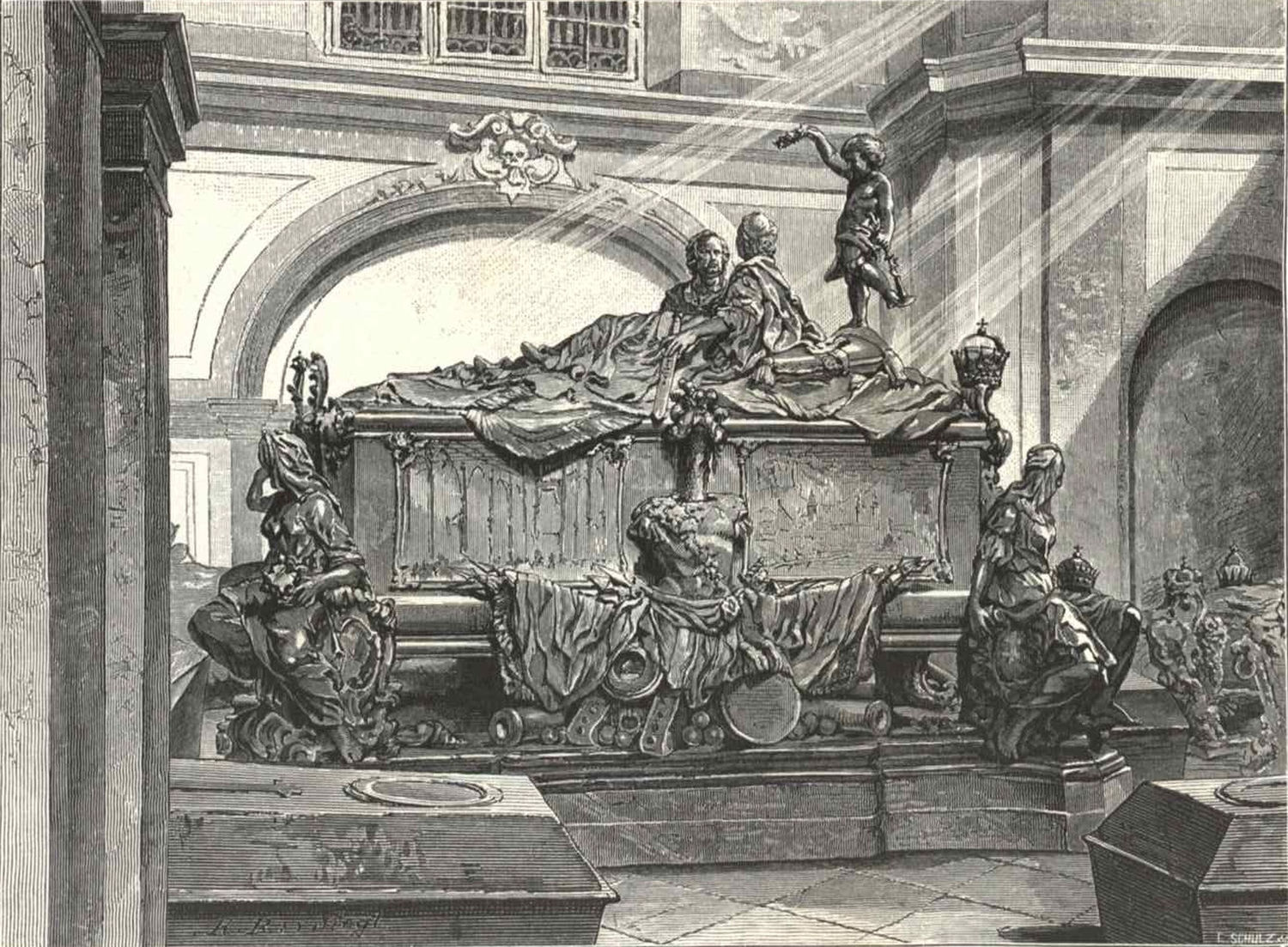
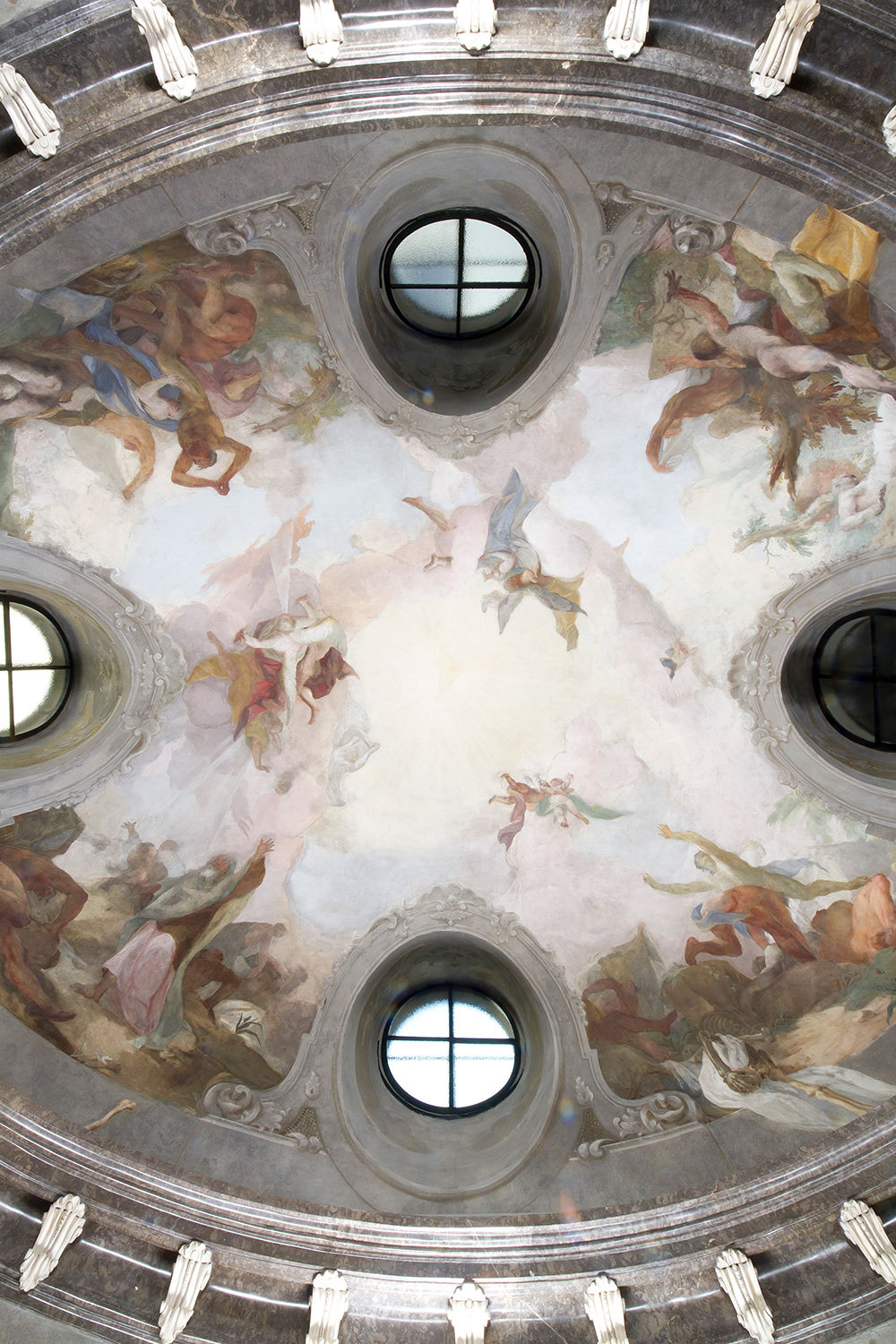
Josef Ignatz Mildorfer completed the dome fresco during the winter. For him, one of Paul Troger's most renowned pupils, the theme – the vision of the prophet Ezekiel – was not new. He had already used it in the arcades of the former Innsbruck cemetery. The following year, on 9 August 1754 – Maria Theresa was 37 years old at the time – Balthasar Ferdinand Moll erected the huge double sarcophagus and received 9,193 florins and 18 1/2 kreuzers for his work.
"Freytag den 20. Sept um 8 Uhr wurde das erweiterte Kayl. Königl. neue grufften gebäu und dabey befindliche Capelle, oder altar von dem hiesigen herrn Ertz Bischoffen Fürsten Trauthson grafen zu Falkenstein in bedienung des Hof-Ceremoniarij gantz in der Stille eingeweiht.“ - "On Friday, 20 September at 8 o'clock, the enlarged new imperial and Royal Crypt Building and the adjoining chapel, or altar, was quietly consecrated by the local Archbishop Prince Trauthson, Count of Falkenstein, in accordance with court ceremony."
A few days later, Maria Theresa had the coffins of her daughters Maria Elisabeth (N°48) and Maria Karolina (N°53) as well as Cauntess Fuchs-Mollarth (N°41) transferred from the old crypt to the new one.
The magnificent giant sarcophagus of the ruling couple, designed by Balthasar Ferdinand Moll, depicts scenes from their lives in the reliefs on the sides. The elegant Rococo coffins of their children, all of whom died before the Empress with the exception of Joseph II. (N°42), are grouped around the parents' metal sarcophagus. At Maria Theresa's explicit request, her governess and later governess to her children, Countess Fuchs-Mollarth, was also buried here in the Capuchin Crypt as the only non-Habsburg, as a sign of her attachment to Maria Theresa. United in death: the tiny infant coffin of Christina (N°51), which was placed under the sarcophagus of her mother Isabella of Parma (N°50), and the poignantly designed coffin with a full-length sculpture of the body of little Maria Theresia (N°52), the dearly beloved child of Emperor Joseph II.
Four daughters of the imperial couple were not buried in the imperial family crypt: Maria Anna (1738–1789, buried in the Elisabethinenkloster in Klagenfurt), Maria Elisabeth (1743–1808, buried in the Jesuit Church in Linz), Maria Amalia (1746-1804, buried in St. Vitus Cathedral in Prague) and Marie Antoinette (1755-1793, wife of King Louis XVI, buried in St. Denis in Paris).
The construction of the Maria Theresa Crypt was supervised by court architect Jean Jadot de Ville-Issey, who, like his patron Emperor Francis I Stephen, came from Lorraine. Jadot (1710-1761), who was educated in France, had already built an antique-style triumphal arch for Francis I Stephen in Florence and followed the emperor to Vienna after his coronation in 1745. Involved in a plot with Nicolaus von Pacassi, he had to leave Vienna in 1753. He created a religious space in the old artistic tradition. A central space with an oval dome was created on a cruciform floor plan. Monumental examples of this type of construction can be found, for example, in the Armenian radial dome buildings. The Iranian, Mesopotamian, Syrian, Asia Minor and Byzantine tombs also correspond to this type, which then experienced a revival in late antique and early Christian mausoleums.
This architectural style reached southern Europe in the early Middle Ages, as exemplified by the tomb of Theodoric in Ravenna. The Italian Renaissance saw a revival of oval domed buildings in architecture. Around 1600, however, circular buildings replaced oval ones on this side of the Alps as well.
The intellectual model for underground tombs is most likely the hypogea of the Etruscans, which can consist of a main chamber with side chambers (for example, the Volumnier tomb near Perugia) or of various burial chambers.
The copper-covered dome of the Maria Theresa Vault rises up to the second floor of the monastery. It is supported by pilasters, which are interrupted by a white cornice.
Light streams down from above onto the sarcophagi through the windows of the dome, which lead to the choir on the east side and the monastery cloister on the south side, ‘as if to bring the dead home to a higher reality’.
Ginhart described the effect of the incoming light on the atmosphere of the room as follows:
‘When the niches lie in the twilight of evening, the pale sea green of the coffins resembling burnt-out mountains, all physicality has completely evaporated, and in a breath-like unreality, the jagged, thorn-like, hacked and torn structures seem to float ghostly.’
In keeping with the spirit of the times and courtly representation, the vault was given a precious coloured decoration – predominantly in marbled, shiny pink stucco. The recessed panels on the crossing pillars are light green-grey, the side walls and spandrels on the blind arches are blue-grey; all cornices and arch surrounds are finished in grey-violet stucco marble, while the skull cartouches at the apexes of the arches and the consoles on the dome cornice are white.
On behalf of Maria Theresa, Josef Ignatz Mildorfer created a dome fresco depicting the prophecy of resurrection according to Ezekiel 37:5: "Ecce ego intromittam in vos spiritum et vivetis.“ – ‘Behold, I will put spirit in you, and you shall live.’ Reddish and white clouds cover the sky with a shimmering haze, from which golden rays emanate. Beneath them lie the corpses. Ezekiel commands the winds, which blow from all directions, to breathe life into the dead bones. They rise up and live: ‘O spirit, come from the four winds, breathe on these dead, that they may live again.’ (Ezekiel 37:9).
The religious message is repeated for the outside observer. The dome is covered with hammered patinated copper plates and crowned by a copper-bronze finial, also known as a lantern.
On a volute-supported, softly curved base with two coats of arms lies a cushion, and on it, above crossed bones, a crowned double skull with an archducal hat. The year 1753 is inscribed on the north side of the base. This dome attachment is the work of Balthasar Ferdinand Moll.
Builder/Donor: Maria Theresa and Kaiser Francis I. Stephan
Architect: Jean Nicolas Jadot de Ville-Issey, Nicolas Pacassi
Architectural style: Rokoko
Sarcophagi:
in the Maria Theresa Vault